

Theology of the Dish Pit
Many who come to Barnabas long for and desire a deeper intimacy with God.
I love how Christ taught and modelled going away in secret to spend time with His Father, and this is the thing Barnabas offers to many people.
When Jesus teaches us about prayer he says, “But when you pray, go into your room and shut the door and pray to your Father who is in secret. And your Father who sees in secret will reward you.” [Matthew 6:6]. It is a humble, intimate act only between the one who prays and the God who sees; this quiet act has the power to shape our internal world and also the world around us.
Barnabas has been frequently referred to as a "Thin Place." For me, this represents a secret space – where God is close and the rest of the world is quieter.
This is the place we have invited the second generation of The Crew to inhabit.
The Crew is a group of nine young adults who arrived at the beginning of September and will be living here for the next nine months. They will be learning to serve, to build community, and hopefully be inspired to live a life of intentional practices that invite them deeper into the heart of God.
Primarily, The Crew will be engaging in the act and theology of hospitality. They will be learning how to host Barnabas guests and each other, and through their stories they will come to a deeper understanding of how God hosts us and has already hosted us throughout our lives.
Hospitality is about welcoming people in and making them feel at home: but ultimately, it is about being seen, known, and loved.
For The Crew, this is practically embodied in the service of running retreats at Barnabas. It is then taken to another level as they learn to care for and hold each other in community.
While hospitality is a posture for life, it is often hard and involves a lot of unseen work.
It is the dish that disappears as you place it down.
The bed that is made for you when you arrive.
The delicious food that appears out of thin air.
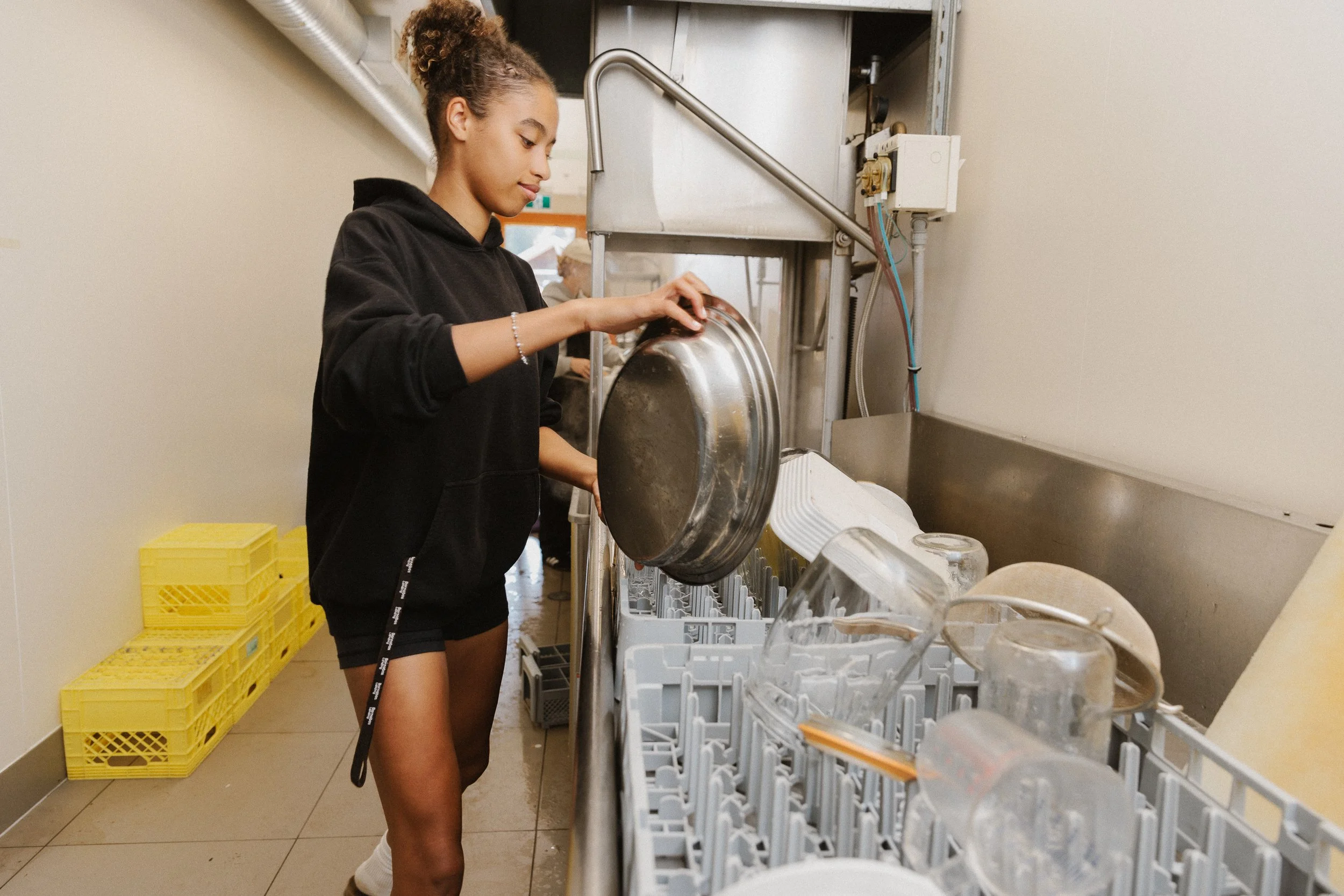
There are many tasks that keep Barnabas running, there are only a few that a guest will witness. Although The Crew will serve in many areas over their nine months here, they will spend a large part of their time in a very secret place indeed - the dish pit.
“If Barnabas is a Thin Place, the most sacred corner of the property, in my opinion, is the dish pit. ”
In the training of The Crew, Kim and I fondly describe the dish pit as a sacred space. It is a place of practical redemption, a place where the work is essential to Barnabas’s mission. It is also thankless, monotonous and repetitive. Many would say it is the task assigned to the least in society, for one needs little training or education, and there is no glory or recognition other than the satisfaction of finishing the last dish, usually in the quiet of a late night.
Yet the dish pit is a forge to shape young leaders into servant leaders. It is a place to test and strengthen seasoned leaders. Here at Barnabas, we’ve made it a privilege for a leader to do a dish shift. Here, no one is above doing the dishes.
We tie our aprons around our waists, fill our sinks and clean the remnants of a hearty feast.
And yet we have realized Christ did it first.
On the night he was betrayed, he took a servant's cloth, tied it around his waist, filled a basin, knelt before his friends and with his hands that would later be pierced, and washed their dusty feet.
Naturally, we search for reasons to motivate us to perform such a thankless task. First (and not wrongly) the thought may be “I serve in the dish pit so that God can do His ministry out there.”
This is true, but there is something more.
Mother Theresa invites us a layer deeper: “Wash the plate not because it is dirty nor because you are told to wash it, but because you love the person who will use it next.”
In my experience, if you lean in and open your eyes, you will see that as you scrub a stubborn pot or clean the same dish for the third time in that day, there is a mysterious holy presence in this ordinary act. Not that you already love the person who will use the dish next, but you learn to love them through washing the dish. Not that doing the dishes must be elevated, but rather as you wash, the very act of doing the ordinary thing - the laying down of your own experience so that a stranger may enjoy a meal and be blessed tomorrow, or even as one washes and redeems each individual plate - it is almost that God is doing his redeeming act in our hearts.
We participate in the action of love first, and find ourselves participating in the holy symphony of love as a result.
The dish pit is also the great equalizer.
As one washes shoulder to shoulder, the ordinary task removes preconceptions of the other to allow room for an honest, holy communion. I have witnessed the redemptive power of the dish pit, heartfelt moments of the most unlikely people delighting in each other, transforming strangers into friends. It is the container for some of the holiest conversations. I have made lifelong friends there — quiet conversations that have shifted the course of my life.
There is a mystery in this humble space.
It is dirty. It is restorative. It leaves our hands wrinkled like raisins, raised in one of the truest acts of worship.
Christ is here.
Here in the steam.
Here in the water.
Here in the tired hands.
Here in the laughter.
Here in the ordinary work that no one sees.
Here in the place where we kneel.
The dish pit is a holy place because it reminds us that the Kingdom is often nearer than we think.
Sometimes it is found behind the kitchen door.
Sometimes it is found in a basin of lukewarm water.
Sometimes it is found in the person standing beside us.
And sometimes, if we are quiet enough to notice, we discover that the hands we thought were only washing dishes are the very hands God is using to wash something clean in us.
So we wash.
And we wash again.
And in the secret place, Christ meets us there.